Cucumber Benefits for Skin: What's Real and What's Hype?
Cucumber is about 95% water, genuinely cooling, and famous for way more than the evidence supports. Here's the honest breakdown — and what it actually does in a soap bar.
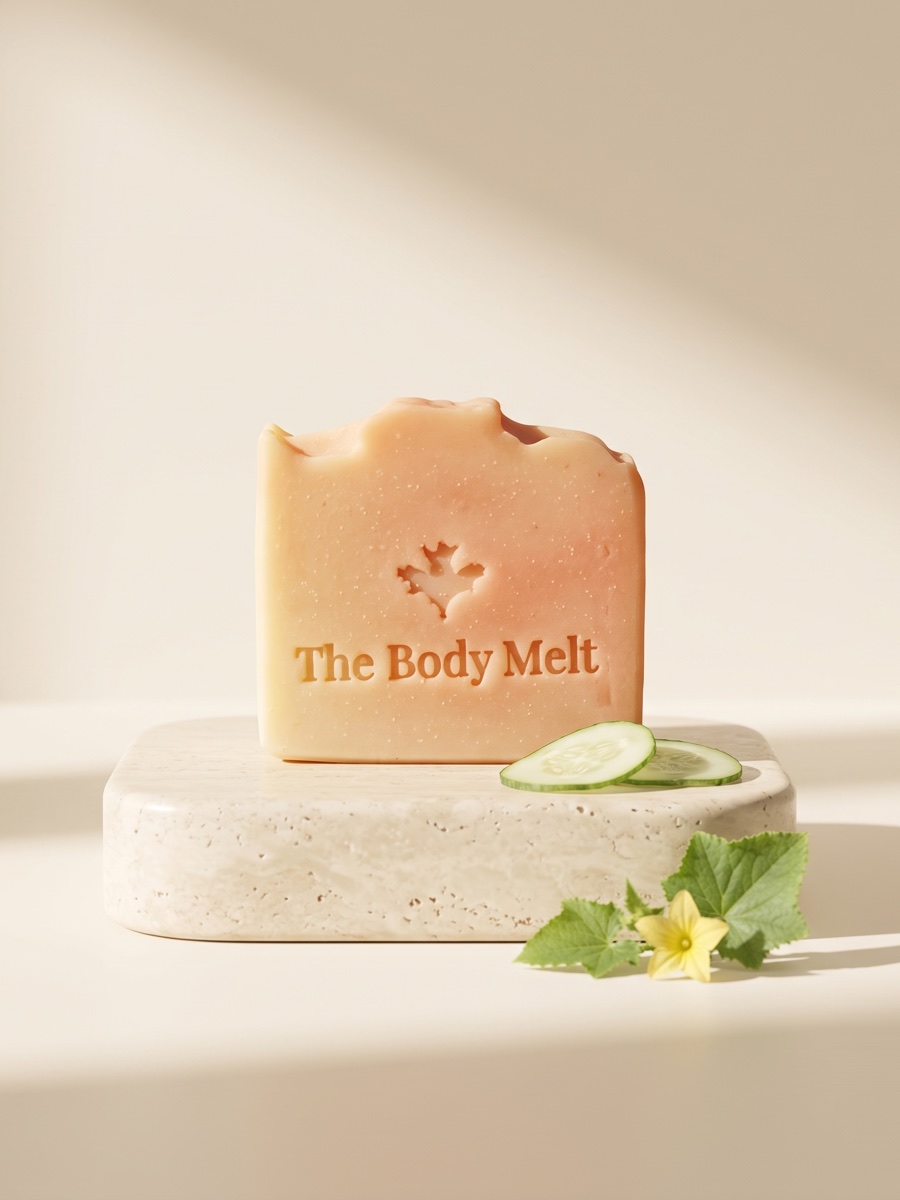
Picture the classic spa poster: someone lying back, towel on their head, two cucumber slices over their eyes. Cucumber has been skincare's mascot for decades — but how much of that reputation is earned, and how much is just a very photogenic vegetable? We put cucumber in a whole soap bar, so we figure we owe you the honest version.
Mostly water — literally
A cucumber is about 95–96% water. That's not a marketing line; it's the actual composition. The rest is a small collection of vitamin C, vitamin K, potassium, and plant compounds like flavonoids and caffeic acid — present, but in modest amounts. This is why cucumber feels the way it does: crisp, cool, juicy. It's basically structured water with a fresh green scent, and honestly, that's a compliment.
The cooling feel is real
Here's a fun fact: the inside of a cucumber genuinely sits cooler than the air around it, and all that water evaporating off your skin pulls heat away with it. So when people say cucumber feels cooling, that's not placebo — that's physics. In Cairo in August, we consider this a feature worth celebrating. That instant "ahh" is the most honest thing cucumber does.
The slices-on-the-eyes story, told straight
Now the part most brands skip. Dermatologists who went looking found no rigorous clinical trials on cucumber slices for puffy eyes — none. The relief people feel comes mostly from the cold itself, not the cucumber: a chilled spoon from the fridge does roughly the same job. So we'll say it plainly: on this one, the hype is bigger than the evidence.
And the soothing part? What the science actually shows
Lab studies on cucumber extract — the concentrated stuff, not slices — have found antioxidant activity and calming signals in cells. Promising? Sure. But these are mostly test-tube and animal studies, and big human trials simply don't exist yet. What we can say with a clear conscience: the water is real, the cooling feel is real, and the mood-resetting scent is very real — the rest is still being studied. And if something on your skin is persistent and bothering you, that's a conversation for your dermatologist, not a vegetable.
So what does cucumber do in a soap bar?
Why did we build Cucumber Melt around it, then? Because cucumber's honest benefits are exactly what a great everyday bar needs. Fresh cucumber goes into the batch, and cold-process soapmaking keeps all the natural glycerine right there in the bar — big industrial makers usually pull it out to sell separately. The result: a bar that cleans properly without that squeaky, tight feeling, with a scent like a cold drink on a hot afternoon.
Sensitive skin is the one that falls hardest for it — light, cool and clean with no harshness, which is exactly what skin that reacts to everything is asking for. If your skin runs oily and wants a deeper clean, Charcoal Melt and Nila Melt are the ones for that job. And if your skin leans dry, Rice Melt is the gentler road.
Questions people ask
Does cucumber brighten or even out skin?
We won't promise that, because the evidence itself doesn't. There's one very small pilot study on a cucumber-extract cream, and one small study is not a promise. What we can say: skin that's cleaned gently and kept comfortable tends to look fresher and clearer — and that's the honest ceiling of the claim.
Is cucumber soap good for sensitive skin?
It has become its home. Cucumber Melt is light and cleans with a gentle coolness, no harshness — exactly what skin that reacts to everything asks for. If your skin runs oily and wants a deeper clean, Charcoal Melt and Nila are the ones for that job. Every skin has its own mood, so give a bar two weeks and let yours vote. If you enjoy straight talk like this, there's more of it in the journal.
Cucumber won't perform miracles — but a cold, green, honest-smelling shower gets pretty close. Cucumber Melt is waiting.