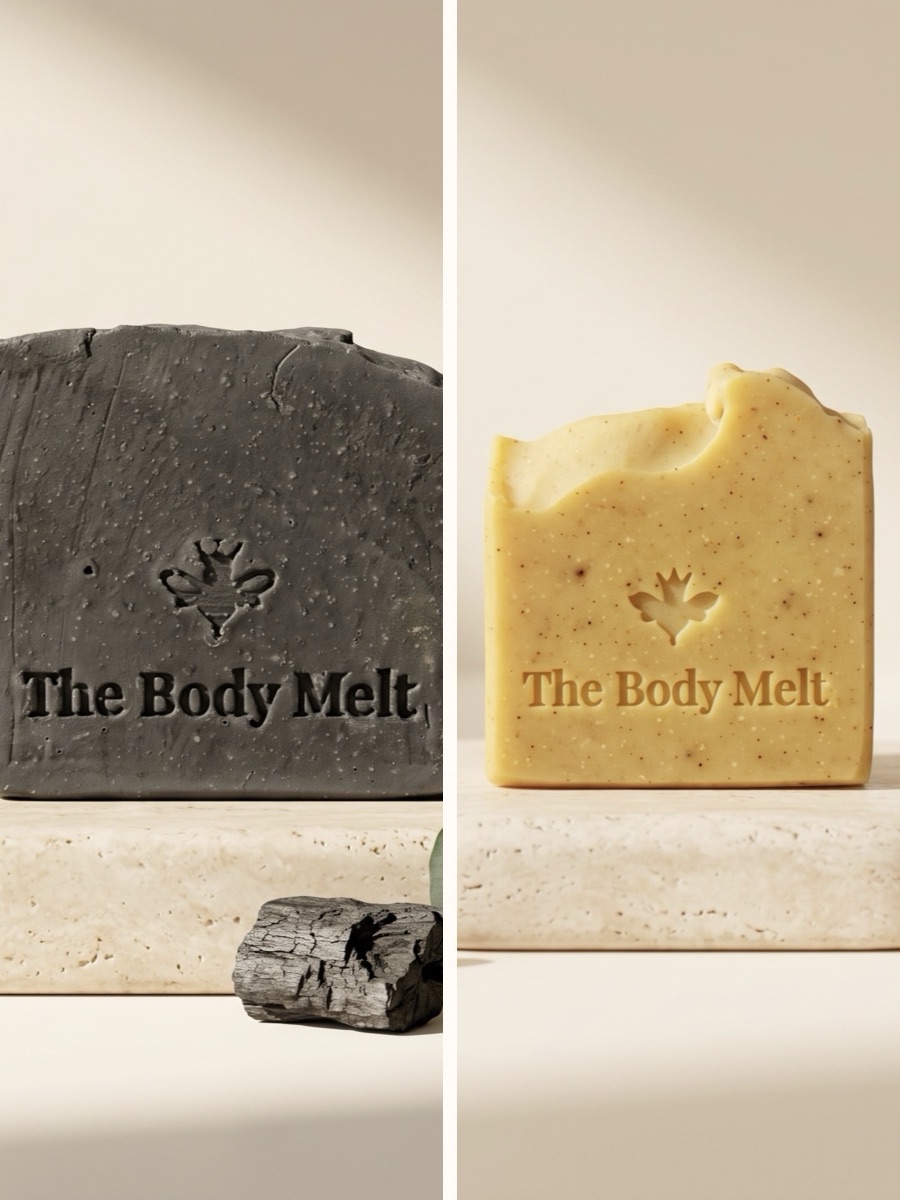
The Signature Pair
459 EGP
Any two Signature bars — Olive Melt, Mint Melt, Nila Melt or Turmeric Melt — for 459 instead of 498. Name your two in the order notes.
In stock · ships within 2 days
Not sure which one? Three questions, about twenty seconds.
What customers say
One moment…
Questions
What is every bar made of?
Every bar shares one base: cocoa, mango and shea butters with olive, castor, sweet almond and coconut oils. All natural — no detergents, no synthetic hardeners, no fillers. Then whatever the recipe calls for is folded in fresh.
How long does a bar last?
Four to six weeks with daily use, if you keep it on a draining dish. Cold-process soap holds water, so a bar left sitting in a puddle will go much faster.
Why does the colour change between batches?
Because the colour comes from food, not dye. Carrots in January are not the colour of carrots in June. The bar is the same; the season is not.
How do I pay?
Cash on delivery anywhere in Egypt, InstaPay transfer, or place the order on WhatsApp and we will sort it with you.
Do you deliver outside Cairo?
Yes — everywhere in Egypt. Delivery is free on orders over 549 EGP.
Why should I buy from you rather than someone else?
Three things, and you can check all of them: • Cold-process — the glycerine the reaction makes stays in the bar. At industrial scale it is usually separated out and sold on its own. • Four weeks curing — water leaves the bar, so it hardens. That is why one lasts weeks in a wet bathroom instead of days. • No detergents, no hardeners, no fillers — the list on each product page is the whole list. We would rather you compared those three than took our word for it.
How is this different from normal supermarket soap?
Mostly two things: • A supermarket bar is usually a detergent bar — made fast, glycerine removed, hardeners added so it survives shipping. • Ours is oils and butters, cut by hand, left four weeks to cure. That is why it feels different on the skin, and why it costs more.
Is it worth the price?
A cured bar lasts four to six weeks with daily use if it sits somewhere that drains. Worked out that way it is not expensive — but you should decide that, not us. Try one bar before you try three.
What does cold-process actually mean?
Oils and lye are mixed at low temperature and left to finish the reaction on their own over several weeks, rather than being cooked to speed it up. The slow route keeps the glycerine that the reaction produces inside the bar. It is the difference between letting bread prove and turning the oven up.
Why does it need four weeks?
The soap is technically soap within a day or two. The four weeks are for water to leave it. A bar that has lost that water is harder, milder, and lasts roughly twice as long in a wet bathroom. Curing is not a ritual — it is the whole reason one bar outlives another.
What is glycerine and why does it matter?
Making soap produces glycerine as a by-product — it pulls water toward the skin, which is why a bar that keeps it feels different in the last rinse. It is also valuable on its own, so at industrial scale it is usually separated out and sold. We leave it where it happened.
Do you use palm oil?
No. It is the cheapest way to make a hard bar and we would rather use cocoa butter and time. That is a choice about how we want to work, and it costs us more — we are not going to pretend otherwise.
How do I make a bar last longer?
Keep it out of the stream and let it dry between showers. A dish that drains doubles its life, honestly — sitting in its own puddle is what kills a good bar. Cutting it in half and keeping one half dry works even better.
Do you sell anything besides soap?
Not yet — soap bars are what we make today. Whipped soap, candles and bath bombs are on the way. Leave your email at the bottom of any page and we will tell you the day something new lands. We also keep a note of what people ask us for, so if you tell us what you were after, that counts.
My skin is oily and I get breakouts — what would you suggest?
Skin like this likes gentleness. Three things: • Twice a day, lukewarm water. • Lather in your hands first — no cloth, no scrubbing. • Pat dry. For the bar: Charcoal Melt or Nila Melt. Both clean without pulling, and rinse clean. Give it two weeks before you decide 💛 And if something is persistent, see a doctor.
My skin is very dry and tight — how should I wash?
Dry skin wants two things: less washing, and moisturiser sooner. • Once a day is plenty, lukewarm. • Put your moisturiser on while skin is still damp — that is the moment it holds. For the bar: Olive Melt or Rice Melt. The gentlest things we make, and their lather is soft and creamy — that is the recipe working 💛
Is it safe if my skin reacts to everything?
The best thing you can do is read the list yourself — every bar shows all of it on its own page, with nothing left off. If you want to try: Olive Melt is the plainest thing we make. Test it on the inside of your arm for a couple of days first — that is what we would do 💛
Is it gentle enough for dry or sensitive skin?
That is what the recipe is built around. Three things do the work: • Superfatting — we leave 5 to 8% of the oils unsaponified on purpose, so free shea, olive and almond stay in the bar and go onto your skin rather than washing away. • Glycerine — around a fifth of the bar by weight. It draws water toward the skin. Industrial soap-makers extract it and sell it separately; we leave it where it forms. • No detergents, no hardeners, no fragrance in the plain bars — the things most often behind tightness and stinging simply are not in there. Olive Melt is the plainest bar we make and the one to start with. Patch test on your inner arm for two days first — that is what we would do 💛
What makes a soap gentle or harsh?
What it is made of, mostly. A bar built on conditioning oils and butters behaves differently from one built on detergents chosen for foam and shelf life. The two that matter most: how much is left unsaponified for your skin, and whether the glycerine stayed in. Both cost the maker money, which is why mass-market bars usually have neither. Also: more coconut oil means bigger bubbles and a stronger clean, so we keep it in proportion. A bar that foams enormously is usually telling you something about what is in it.
Will it clog my pores?
No — and this one is worth explaining, because coconut oil has a reputation. Raw coconut oil does rate high for clogging pores. But there is no coconut oil in a finished bar: saponification turns it into sodium cocoate, a different molecule that does not behave the same way, and it rinses off rather than sitting on the skin. The same is true of every oil we start with. So a coconut-oil soap is not the same proposition as coconut oil on your face. Two different things with one name.
Is your soap pH balanced?
No, and no real soap is — that is worth knowing rather than guessing at. Saponification produces an alkaline salt, so every true soap sits around pH 9. Anything sold as a pH-balanced "soap" at 5.5 is a synthetic detergent shaped like a bar. Both are legitimate products; they are just not the same thing. On healthy skin the surface returns to its normal pH within about half an hour to a couple of hours. What we do about it is build the bar to be kind on the way through — superfat, glycerine, no detergents. If you have a diagnosed skin condition and your doctor has told you to use a soap-free cleanser, follow your doctor, not us.
What is the difference between your bars — do they not all just clean?
They all clean. What they do besides that is where they differ, and it is worth picking on purpose: • Calming — Olive Melt, Rice Melt and Cucumber Melt. High superfat and a quiet lather — with Cucumber Melt adding a light coolness. For sensitive skin, and skin that feels tight or looks angry. • Clarifying — Charcoal Melt and Nila Melt. Clay and charcoal lift oil off the surface rather than dissolving it. For skin that feels congested by evening. • Polishing — Mint Melt. Fine black seed, two or three times a week. Not a daily bar. • Glow — Carrot Melt, Pineapple Melt and Turmeric Melt. Warm colour and light. Cosmetic, and we will not claim more than that. Most people end up with two: something calming for most days, something clarifying or polishing for the rest.
How is natural exfoliation different from the scrubs sold in shops?
The difference is control, mostly. Black seed and clay work on the surface and stop the moment you rinse. You decide how much and when, and the effect ends with the shower. Acid exfoliants — the ones on most shelves — keep working after you rinse, which is exactly why they are effective and exactly why over-use is such a common problem with them. Neither is better in the abstract. But one is harder to overdo. Either way, two or three times a week is plenty, and never scrub — lay the lather on and let it do the work. Scrubbing irritates skin, which is the thing you were trying to avoid.
Which one should I use every day?
A calming one — Olive Melt or Rice Melt. They are built for repetition: high superfat, gentle lather, nothing sharp. Keep the polishing bar for two or three times a week, and the clarifying ones for when your skin actually feels congested rather than out of habit.
Who is behind TheBodyMelt?
TheBodyMelt is a trademark of TBM Cosmetics, a registered Egyptian joint-stock company. Every bar is made by hand in Cairo, in small batches, and sold only in Egypt.
Is there a soap that treats acne?
A bar can help reduce the appearance of blemishes with regular use: it clears the excess surface oil that blocks pores, and clearer pores mean fewer spots showing. The ones that do that work here: • Charcoal Melt — for oily and combination skin • Nila Melt — the same job, gentler if your skin reacts • Turmeric Melt — turmeric and frankincense together • Pineapple Melt — gentle fruit-acid exfoliation, and very good for body and back Give it two to three weeks before you judge. And if the breakouts hurt or leave marks, see a doctor.
Does charcoal soap help with acne?
Yes. Charcoal lifts oil and sweat off the surface and rinses out completely, and less oil sitting there means fewer blocked pores — which helps reduce the appearance of blemishes with regular use. Charcoal Melt is the strongest of ours for oily skin. If your skin reacts easily, Nila Melt does the same job more quietly.
Which of your bars is best for skin that breaks out?
Four of ours do that work: • Charcoal Melt — oily and combination skin; clears oil and rinses clean • Nila Melt — the same job, gentler if your skin reacts • Turmeric Melt — turmeric and frankincense, and it helps even out tone too • Pineapple Melt — gentle exfoliation, and the best pick for body and back Twice a day with lukewarm water, lather in your hands rather than scrubbing, and give it two to three weeks before you judge.
Do you have anything for back and body acne?
This is where a bar has its best case. Body skin takes a proper wash in a way a face does not, and a soap gets real contact time there — no cream competes. Pineapple Melt for the gentle fruit-acid exfoliation, or Charcoal Melt if your back gets oily. Both help reduce the appearance of blemishes with regular use. Lather, leave it thirty seconds, rinse.
Why do I get spots on my back?
The back has more oil glands than almost anywhere else, and it spends the day under fabric, in heat, with sweat that does not evaporate. That is oil plus friction plus warmth — the three things that block a pore. Washing it properly at the end of the day is the single biggest thing you can change, and a bar is the honest tool for it.